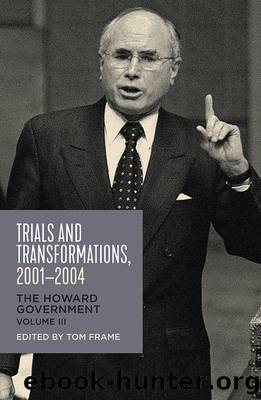
Trials and Transformations, 2001â2004 by Frame Tom;
Author:Frame, Tom;
Language: eng
Format: epub
Publisher: University of New South Wales Press
14
IRAQ AND THE POLITICS OF ALLIANCE RELATIONSHIPS
ALBERT PALAZZO
A decision to go to war is always the result of a calculation weighing the presumed benefit of going to war against the anticipated costs, and comparing these with the prospects of success. It is a highly rational process and all states â and non-states â assess these factors before deciding to go to war. Even the non-aggressor in a war makes this calculation: it must decide to resist or to concede. These are all enduring features of war.1
The goal desired or the projected cost are not the key factors in calculating the decision, but rather the accuracy of the data and the degree of honesty sustained in conducting the analysis. Data is notoriously incomplete or inaccurate, while honesty in decision-making can be corrupted by ideology, greed, wistfulness, the intellectual shortfalls of the decision-makers and a host of other human frailties. Many such decisions fall prey to hubris and irrationality; for example, Japanâs decision to attack the United States in the Second World War. In making the calculation, the enemyâs fighting ability and the strength of its military personnelâs will â and the will of the opponentâs civilian population â may be impossible to assess reliably. Even the strength of oneâs own forces may prove difficult to appreciate. The American historians Williamson Murray and Allan R Millett in their groundbreaking study of net assessment have rightly described the assessment of strengths and weaknesses as âthe most intractable problem of defence planningâ.2
I will look at the nature, quality and honesty of the calculations the United States and Australia made in deciding to initiate a war with Iraq in 2003. My aim is to throw light on the priorities of these two allies and, in doing so, demonstrate that the processes they employed were severely flawed. The consequences of their decisions continue to play out in Iraq, throughout the Middle East and elsewhere.
War goals
As close partners, the United States and Australia usually seek the same war goals. This was not the case in 2003. Both countries went to war to advance their own priorities. In international relations, it is to be expected that governments will put their national interests first; coalition operations are no exception.3 In the case of the war with Iraq, however, the goals of the United States and Australia differed widely. While not contradictory, they did not have the same centres of gravity, nor was their geographic focus in the same theatre of operations. This divergence in ambitions was not for public consumption. Both Australia and the United States repeatedly stated that the reason for the war was to locate and destroy Iraqâs weapons of mass destruction (WMDs). George W Bush, the United States president, and John Howard, the prime minister of Australia, frequently reiterated the need to prevent such weapons from falling into the hands of terrorists who might then use them against their respective homelands. Iraq was to be disarmed of its WMDs and prevented from producing more. As war
Download
This site does not store any files on its server. We only index and link to content provided by other sites. Please contact the content providers to delete copyright contents if any and email us, we'll remove relevant links or contents immediately.
Personalized inhaled bacteriophage therapy for treatment of multidrug-resistant Pseudomonas aeruginosa in cystic fibrosis by unknow(208847)
CONSORT 2025 statement: updated guideline for reporting randomized trials by unknow(102477)
Critical evaluation of the ProfiLER-02 study design and outcomes by Vivek Subbiah & Razelle Kurzrock(102013)
Cardiac gene therapy makes a comeback by Oliver J. Müller & Susanne Hille & Anca Kliesow Remes(101805)
Whisky: Malt Whiskies of Scotland (Collins Little Books) by dominic roskrow(74596)
Unveiling the design rules for tunable emission in graphene quantum dots: A high-throughput TDDFT and machine learning perspective by Şener Özönder & Mustafa Coşkun Özdemir & Caner Ünlü(50986)
A yeast-based oral therapeutic delivers immune checkpoint inhibitors to reduce intestinal tumor burden by unknow(40363)
Covalent hitchhikers guide proteins to the nucleus by Alexander F. Russell & Madeline F. Currie & Champak Chatterjee(40284)
Meet the Authors: Christopher R. Mansfield and Emily R. Derbyshire by Christopher R. Mansfield & Emily R. Derbyshire(40187)
Alkaline-earth metals promote propane dehydrogenation with carbon dioxide through geometric effects: Altering the reaction pathway by unknow(32806)
Induced iron vacancies boosting FeOOH loaded on sustainable Fenton-like collagen fiber membrane for efficient removal of emerging contaminants by unknow(32602)
Efficient electric-field-assisted photochemical conversion of methane to n-propanol exclusively over penetrated TiO2Ti hollow fibers by Guanghui Feng(32520)
Bi2SiO5 nanosheets as piezo-photocatalyst for efficient degradation of 2,4-Dichlorophenol by Hangyu Shi & Yifu Li & Lishan Zhang & Guoguan Liu & Qian Zhang & Xuan Ru & Shan Zhong(32459)
A novel NDIPTA organic heterojunction photocatalyst with built-in electric field for efficient hydrogen production by Jiahui Yang & Baojun Ma & Yongfa Zhu(32432)
Enhanced conversion of methane to liquid-phase oxygenates via hollow ferrite nanotube@horseradish peroxidase based photoenzymatic catalysis by Jun Duan & Shiying Fan & Xinyong Li & Shaomin Liu(32397)
Ordered macroporous superstructure of defective carbon adorned with tiny cobalt sulfide for selective electrocatalytic hydrogenation of cinnamaldehyde by Xiao-Shi Yuan & Sheng-Hua Zhou & San-Mei Wang & Wenbo Wei & Xiaofang Li & Xin-Tao Wu & Qi-Long Zhu(32321)
What's Done in Darkness by Kayla Perrin(27236)
Topological analysis of non-conjugated ethylene oxide cored dendrimers decorated with tetraphenylethylene: Insights from degree-based descriptors using the polynomial approach by A Theertha Nair & D Antony Xavier & Annmaria Baby & S Akhila(26617)
Investigation of mechanical and self-healing properties of hydroxyl-terminated polybutadiene functionalized with 2-ureido-4-pyrimidinone by Mohsen Kazazi & Mehran Hayaty & Ali Mousaviazar(26546)
